A Quiet Hour at the Water’s Edge
A quiet hour at the water’s edge can reveal how a pond changes over time; learn what to watch, record, and leave untouched during a calm visit.
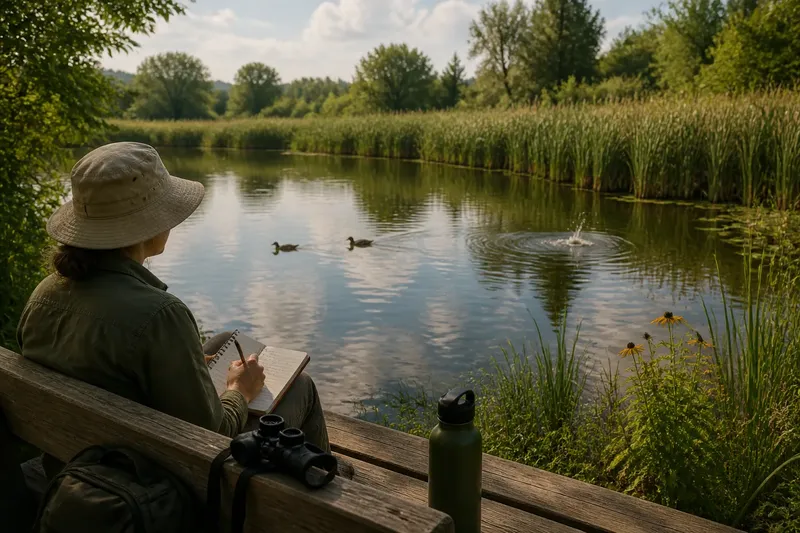
What can you notice during a quiet hour at the water’s edge without turning the visit into a search for wildlife? Choose one permitted viewpoint and watch how the scene changes while you stay put. A pond may seem still at first; then a breeze shifts the reflections, insects skim the surface, or a bird crosses the same opening twice.
Choose one viewpoint
Pick a bench, established path, or public viewing platform with a clear view and room for others to pass. Avoid narrow banks, reed beds, and gaps in vegetation: these can be travel routes or cover, even when they look like convenient places to sit. Follow signs and closures, and leave if your presence blocks a path or changes how animals move.
The point of a sustained visit is to stay with one scene, not to edge around the pond for a better angle. Settle where you can see a few features at once, such as open water, a patch of shoreline, and the tops of nearby plants. Keep binoculars, a pencil, and a pocket notebook close at hand so you do not need to rummage when something happens.
Let the scene change
Begin with a broad look, then let your attention rest on one layer at a time. Watch reflections and ripples on the surface; check the boundary between water and plants; then listen for calls, wingbeats, splashes, and intervals of quiet. A breeze can move leaves without disturbing the water, while a ripple may travel across a reflection from outside your view.
Notice repetition and change rather than waiting for a dramatic sighting. Does the same patch of water keep drawing insects? Does a bird cross the opening and disappear into cover? Record what is visible, not a reason you cannot confirm. “A small bird crossed the opening twice” is a careful note; “it was patrolling for food” is an interpretation.
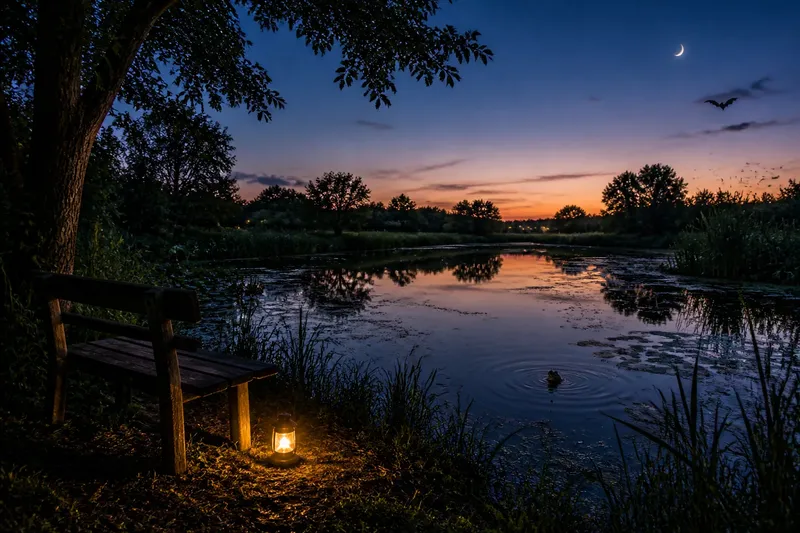
Imagine you settle on a public bench beside a pond, with open water ahead and reeds across the far bank. Your notebook starts with “cloudy, light breeze; two birds crossed the open water.” You then notice that the second crossing follows a splash near the reeds, so you add that sequence without claiming the splash caused it. The useful result is a clearer record of timing and movement, while the birds continue at a distance.
Keep a quiet rhythm
Arrive without fanfare: walk at an easy pace, speak softly, and avoid repeated trips toward the water. Keep snacks, wrappers, and drink containers with you. Follow local rules for dogs, and keep a permitted dog under close control and away from wildlife.
Stay in one position if the view remains safe and unobstructed. If you cannot see well, accept the limited view or move back along the path rather than circling closer. Do not call to animals, offer food, play recorded calls, use flash, or approach nests and young. Binoculars can bring distant details into view without changing your distance.
Watch for a shift in behavior: an animal may stop feeding, repeatedly look toward you, enter cover, or change its route. These signs can have other causes, so treat them as a reason to give more space, not as proof of what the animal feels. Become still, retreat along the path, or leave the area.
Make useful field notes
A short record can capture a sequence that memory blurs. Note the place in general terms, the conditions you can observe, what an animal did, and where it went. Keep the location broad if a sighting involves a nest or vulnerable wildlife; avoid sharing precise details that could draw unwanted visitors.
- Viewpoint: Check that you are on a permitted path or platform; if access is allowed and the route stays clear, settle there, otherwise choose another viewpoint.
- Shoreline: Check for a closure, nest, or animals repeatedly using the nearby bank; if any are present, move farther away, otherwise remain on the established path.
- Animal movement: Check whether an animal pauses, enters cover, or changes direction after you arrive; if it does, increase your distance or leave, otherwise keep watching without approaching.
- Sound: Check whether a call or splash repeats and where it seems to come from; if the source is unclear, record the sound without assigning an animal, otherwise note the visible source cautiously.
- Photographs: Check whether you can frame the scene from your permitted spot without flash; if not, put the camera away, otherwise take a quiet image and stop if behavior changes.
- Collected objects: Check whether a feather, shell, or plant is tempting you to pick it up; if so, leave it in place and make a note or photograph from the path, otherwise continue observing without handling habitat materials.
A phone can hold a brief note or a location-free image, but silence its notifications before you settle in. A local nature organization’s identification app or field guide can help check a sighting later. Keep your equipment secondary to the view; the visit should not become a series of searches through a screen.
When should you move?
Leave when wildlife changes its behavior around you, visitors need the space, or you notice a sign or barrier you missed. If the scene remains undisturbed but your attention fades, it is fine to end the visit rather than keep shifting for a new view. Take your belongings and any litter you can safely reach from the path; do not enter sensitive vegetation or handle unfamiliar material.
Before you go, look across the pond from where you are instead of returning to the water’s edge for one last view. A quiet hour at the water’s edge is most useful when the notes preserve what happened in sequence and your route leaves the habitat undisturbed.
Questions about a quiet visit?
How long should I stay?
Stay while you can remain attentive, still, and out of the way. There is no need to wait for a particular animal or event.
What if nothing appears?
Record the conditions and changes you can see, such as wind moving reeds or ripples crossing open water. Do not enter cover or make noise to draw animals out.
Should I sit or stand?
Either works on a stable, permitted surface that does not block the route. Use a bench if it helps you stay settled, or stand at a viewpoint where sitting would obstruct others.
Can I photograph wildlife?
Photograph from an allowed spot without flash or calls to attract an animal. Stop and give more space if its behavior changes.