Tracks in Mud or Snow: Which Clues Last Longer?
Tracks in mud or snow change in different ways. Learn which details each surface preserves, what distorts them, and how to read a trail cautiously.
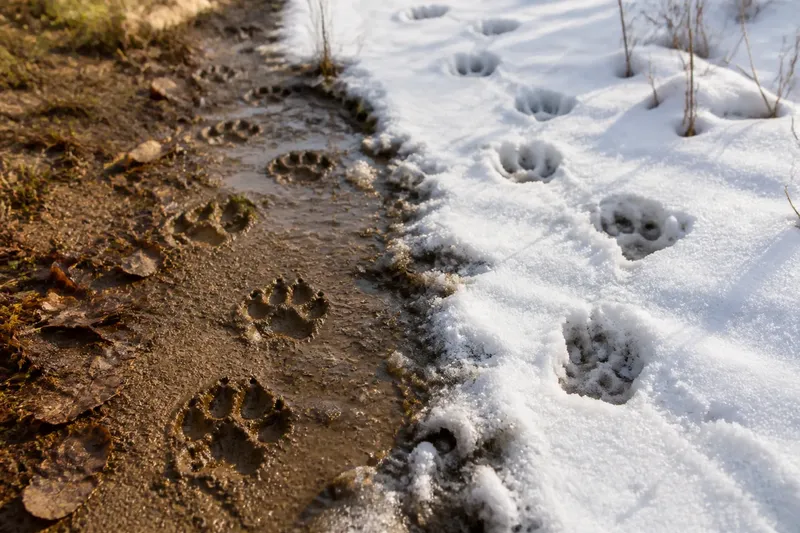
Tracks in mud or snow can look like clear answers until a softened edge, crust of ice, or gust of wind changes the story. Which clues last longer? It depends on the ground, the weather, and the particular detail you hope to read: snow may retain a crisp outline briefly, while firm mud can hold a durable impression after loose snow has shifted.
Think of a track as a record being edited by its surroundings. The mark may outlast some details and lose others, so a careful observer asks not just what made it, but what happened to the surface afterward. That distinction helps you describe evidence without turning a plausible guess into a definite identification.
Edges Tell Different Stories
Fresh, damp mud can take a sharply defined print, including toe marks and the outline of a pad or hoof. As it dries, the edges may crack or curl; if rain falls, the impression can soften, fill, or wash away. Fine, silty mud often blurs sooner than cohesive clay, while a print in firmer ground may remain legible after the surrounding surface changes.
Snow has its own brief window of clarity. In soft, newly fallen snow, a foot can leave a clean rim and internal marks. Later, warmth can round the edges and settle the snow; wind can dust the print, scour it, or build a small drift inside it. A crust may preserve the shape, but a foot breaking through it can make a ragged hole that hides the original outline.
So “lasts longer” has two meanings. A mark can remain visible while losing the fine details needed to interpret it. A less dramatic print may stay readable because its edges and spacing have changed little.
When Prints Look Blurred
A blurred track is not automatically old. In mud, water can spread a fresh impression almost at once, especially where a shallow puddle or trickle crosses the path. In snow, drifting flakes can soften a recent print, while melting can turn separate impressions into rounded depressions. Look for nearby sheltered prints and compare how much detail each retains before estimating relative freshness.
Try reading the surrounding surface, not only the hollow. Is there a sharp edge on the sheltered side? Does the track cross a wet patch where water could have run into it? Are nearby leaves, grass blades, or snow crystals disturbed in a similar way? These clues can suggest whether weather or the animal’s passage caused the blur, but they rarely settle the timing by themselves.
If the print is too soft to show toes or hoof divisions, record it as a general shape rather than filling in missing parts from expectation. A broad oval impression might fit more than one animal, and melting can merge separate features. A cautious note—“rounded, shallow print in wet mud”—is more useful than a confident species name attached to a damaged mark.
When One Track Becomes Several
Snow can hide track boundaries when a foot punches through a crust or slides along a slope. A broken edge may make one print appear to be two; snow kicked forward can create a mound that looks like another impression. Mud can distort a trail in the opposite way: water-filled depressions may join, making separate steps resemble a continuous groove.
Follow the sequence only as far as the ground allows. Compare the spacing and direction of several marks, then pause where the substrate changes. A trail crossing from mud onto snow does not preserve a perfect comparison: the two surfaces accept pressure differently, and a stride can look wider or shorter because the print spreads or collapses.
Say you find a shallow trail crossing a muddy bank and continuing onto fresh snow. At the bank, water has softened the edges; on the snow, a crust breaks beneath some steps. You could note the line of travel and the repeated spacing, then leave the maker uncertain rather than treating the jagged snow holes as the animal’s true foot shape.
When Direction Seems Unclear
People often read direction from a tapered end or a raised lip, but either can mislead. In mud, displaced soil may pile at the front or side of a print, depending on the angle and softness of the ground. Snow can collect in a hollow or form a wind-made ridge after the track was left. Neither feature is a dependable arrow on its own.
Look for a run of marks and changes around them. A consistent sequence may offer a better sense of travel than one isolated print, especially if the trail passes around an obstacle or toward a clear opening. Even then, a turn, backtrack, or pause can complicate the line. Treat direction as a reading of the visible sequence, not proof of where an animal went next.
Questions About Track Clues?
Do snow tracks last longer than mud tracks?
Not in every setting. Cold, sheltered snow can retain a recognizable outline, while firm mud can preserve an impression after a light snowfall has shifted; warmth, rain, wind, and surface texture change the comparison.
Can a track show how recently an animal passed?
It can offer clues, such as crisp edges or undisturbed snow crystals, but weather may alter a fresh mark quickly or leave an older one looking sharp. Describe the visible condition and nearby context rather than assigning an exact age.
Why do tracks change shape across one trail?
Ground firmness, moisture, slope, and snow crust can vary over a short distance. The animal may also change pace or angle, so different-looking prints do not necessarily mean different species.
Should I photograph or measure a track?
A photo can preserve the arrangement and surrounding surface, especially with a ruler or familiar object placed beside the mark without touching it. Follow local guidance and avoid disturbing the track or nearby habitat; measurements support a description but do not establish identity alone.
Record What Remains
For a useful field note, separate observation from interpretation. Write down the substrate, whether it is wet, crusted, sheltered, or exposed, and which details remain visible: outline, internal marks, spacing, or direction. A phone photo taken from directly above can help, but include a scale in the same plane as the print and avoid stepping across the trail.
When comparing tracks in mud or snow, the best clue is often not the sharpest-looking print but the one whose condition you can explain. A concise record of what the ground preserved—and what weather may have changed—lets you revisit the evidence without pretending the surface told the whole story.